PARTS OF THE JAPANESE SWORD
NAGASA
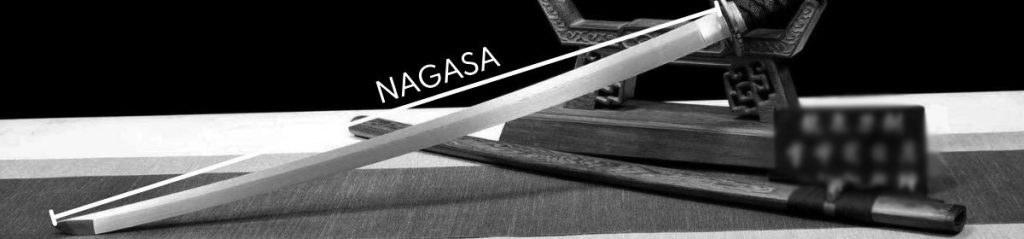
The NAGASA of the KATANA refers to the length of the blade. It is found by measuring in a straight line from the notch at the back of the HABAKI, called MUNEMACHI, to the tip of the blade.
SORI
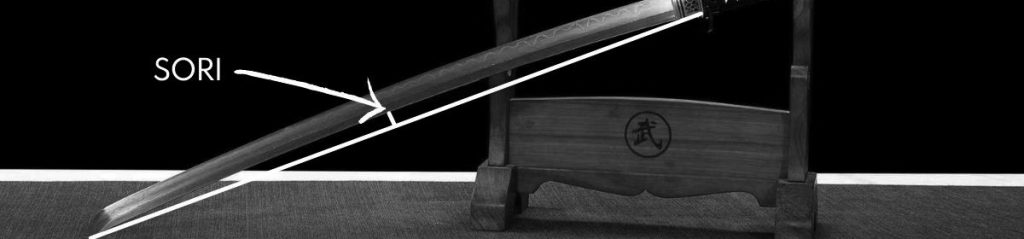
The SORI measures the curvature of the blade. This curvature can vary according to the katana and has several names depending on the intensity of the curvature.
SHINOGI and SHINOGI-JI
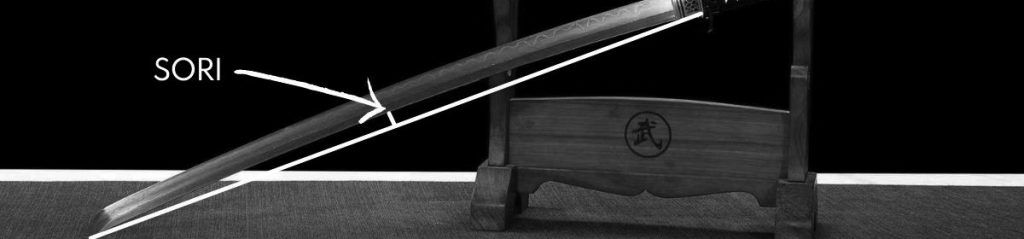
These two Japanese terms are complementary. The SHONOGI is the part from the edge of the blade to the line that determines the flat of the blade. The flat section of the blade is therefore called SHINOGI-JI.
HAMON, BOSHI and YOKOTE
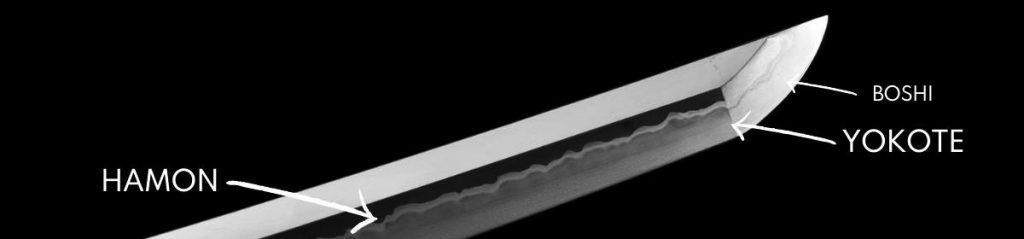
The HAMON is the line of tempering that demarcates the most rigid and sharp part of the blade with the other, more flexible part. We coat part of the blade with a clay mixture that we will heat and temper, the part with the clay will cool much faster and will be more rigid and sharp.
BOSHI
This part refers to the hardening line of the HAMON which extends to the tip (KISSAKI). The polishing of this point can take a long time, as it is very important. It is as important as the rest of the blade and reveals the BOSHI.
YOKOTE
YOKOTE is the fine delineation between the KISSAKE and the rest of the blade. Almost all KATANAS have this feature, there are some exceptions with swords without YOKOTE where the blade is continuous along the whole length.
KISSAKI
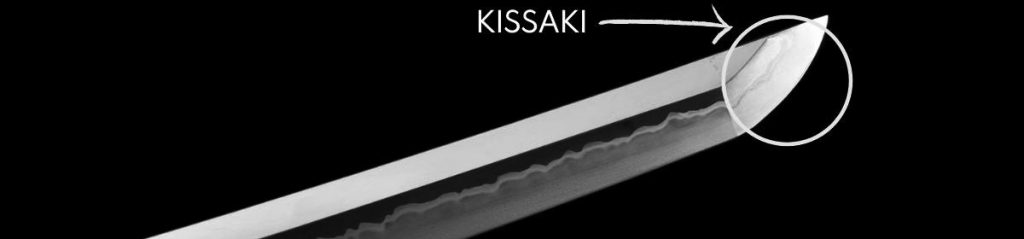
The KISSAKI is the tip of the sword. This tip separates the rest of the KATANA blade from the YOKOTE.
HA
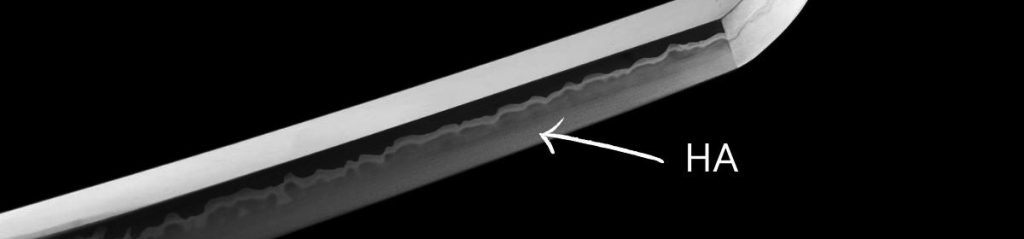
The HA is the cutting edge of the blade. It is this part that is usually hardened with the HAMON in the traditional way. The sharpening of this part as well as the hardening and the steels used will determine the quality of the edge, but also its rigidity and solidity. It is important to have a blade that lasts over time and can withstand many cuts.
BOHI
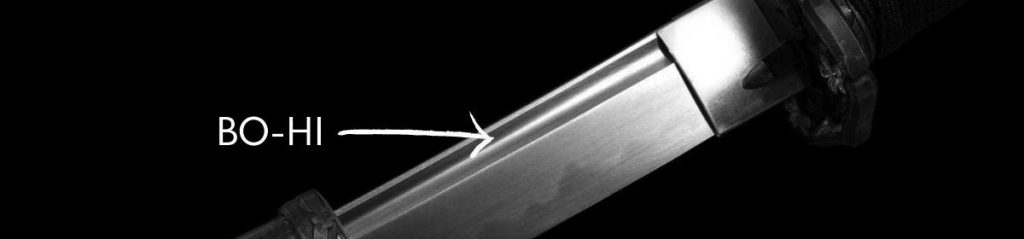
The BO-HI is a line carved inside the blade of the KATANA/IAI that allows to reduce the weight of the blade, but also to adjust the balance point of the sword. This bo-hi throat is also useful for the sound, because it allows to know if the cut whistles, as does the sound of the wind.
SAYA (SCABBARD)
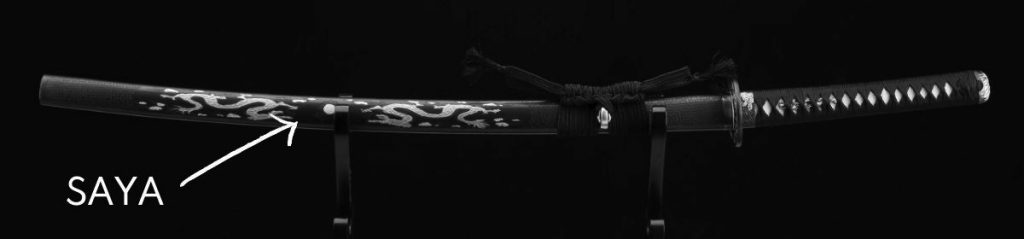
The SAYA is the scabbard. This SAYA is designed to draw the blade as quickly as possible. Its size is also specific for holding the KATANA/IAI without it falling out. This SAYA is usually made of lacquered wood with various patterns and colours.
SHITADOME, KURIGATA and SAGEO
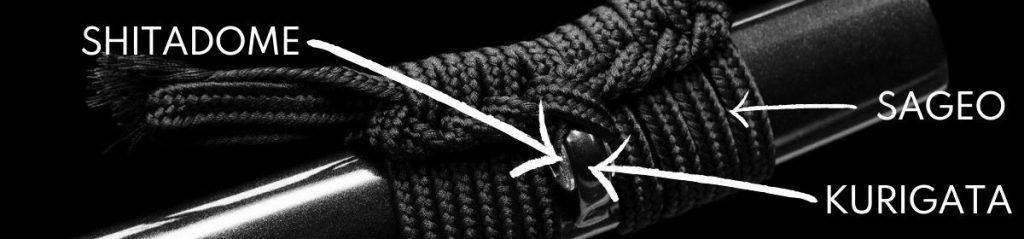
These two parts are a pair. This small part allows to tie the SAGEO which will be then hung on the belt/obi. This brings a practical side as well as aesthetics to the SAYA.
The SAGEO is the cord that allows the KATANA/IAI to be attached to the belt (obi).
HABAKI and SEPPA
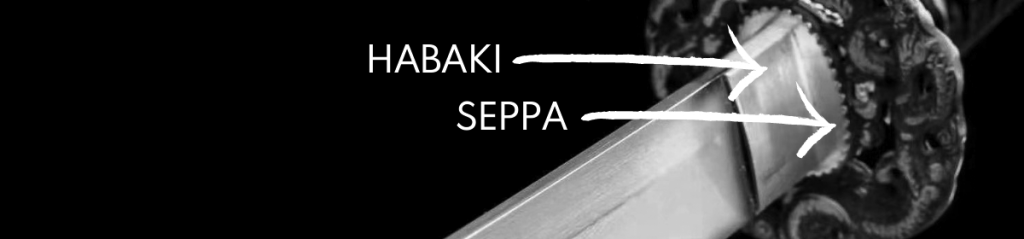
The HABAKI allows the blade to fit snugly and firmly in the SAYA and also allows reducing the shocks and vibrations felt in the handle during a cut or thrust.
The SEPPA are two small washers to fill the gaps between the TSUBA and the TSUKA, as well as the HABAKI and the TSUBA.
TSUBA
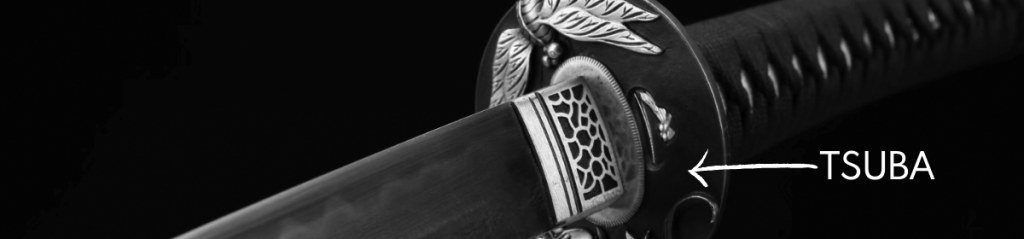
The TSUBA is the guard of the KATANA/IAI. It protects the hand while also preventing the hand from sliding forward. It also allows for weight and balance.
FUCHI and TSUKA-ITO
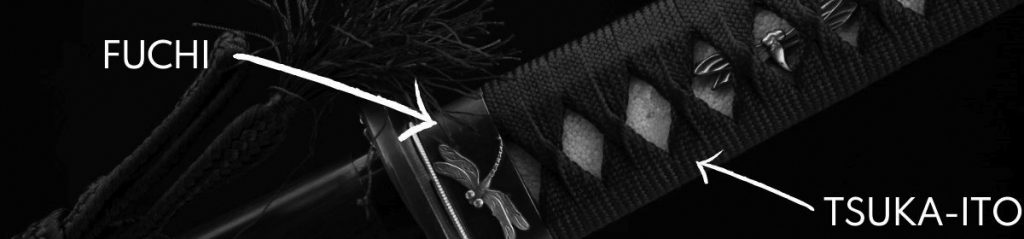
The FUCHI is a metal talisman that reinforces the structure of the tsuka, but also disguises the SAME (pronounced sahmay). They are generally two, carved in traditional patterns.
The TSUKA ITO is the flat cord used to wind the handle (SAME). There are different techniques and materials for this. The TSUKA ITO can be made of leather, cotton or other materials.
MEKUGI and SAME
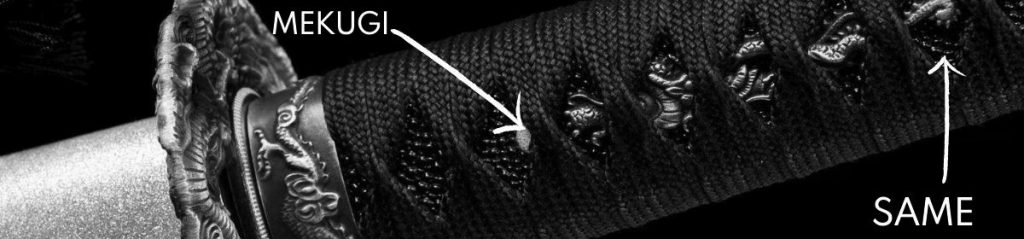
The SAME is stingray or shark skin, this material allows the TSUKA ITO to hold well.
MEKUGI are wooden pegs (usually two). These help to fix the handle to the blade by passing through the NAKAGO (tang). They are hammered into place by a small brass hammer, the wider end against the palm of the hand to prevent the fittings from dislodging. These can be carved from the thin end of wooden chopsticks.
MENUKI
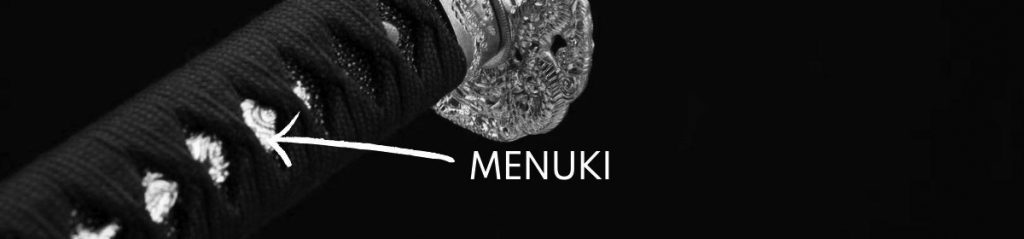
These are ornaments made of different materials like copper or brass. They are used to facilitate the grip, but also to decorate the TSUKA with the FUCHI.
KASHIRA

The KASHIRA is the pommel of the KATANA/IAI, it is made with the FUCHI (similar patterns are often found between the two).
KOIGUCHI
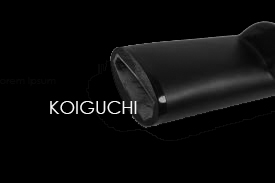
The KOIGUCHI is the part of a SAYA that mates with the HABAKI and sits the blade comfortably inside the scabbard. Ideally, it is reinforced to prevent the blade from accidentally cutting through the SAYA when quick drawing the KATANA/IAI. When perfectly fitted, the sword can be turned upside down in the SAYA without falling out, but can be easily released from the scabbard with pressure from the thumb on the TSUBA.
The inside of the KURIGATA is part of the wooden SAYA and is made from the same type of wood as the rest of the scabbard. It quite often requires replacement and wood shavings or laminate is often used, shaped and glued to reinforce where the KISSAKE flicks from the SAYA into the cut.
NAKAGO
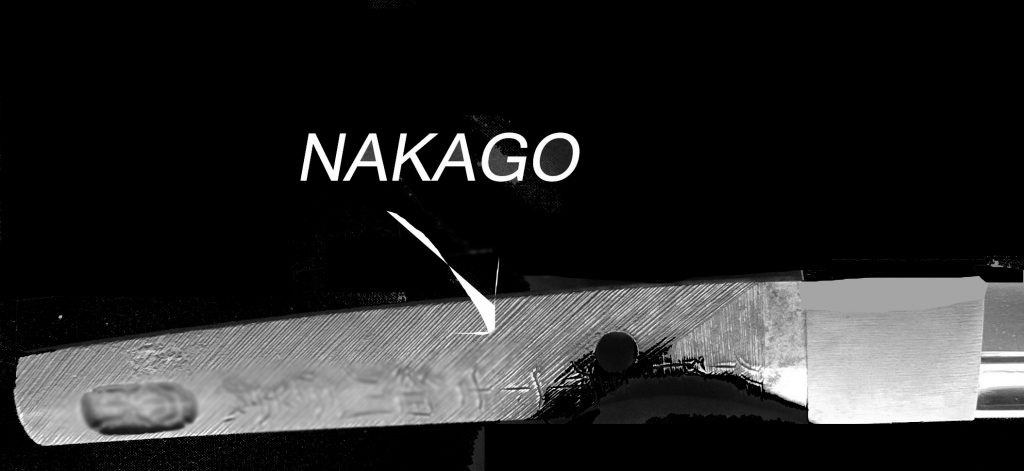
NAKAGO is the tang of the sword, beneath the fittings of the TSUKA. It usually will describe the kanji of the maker and sometimes the family name. NAKAGO traditionally has two holes to support the MEKUGI.
For cleaning and maintenance see HERE.